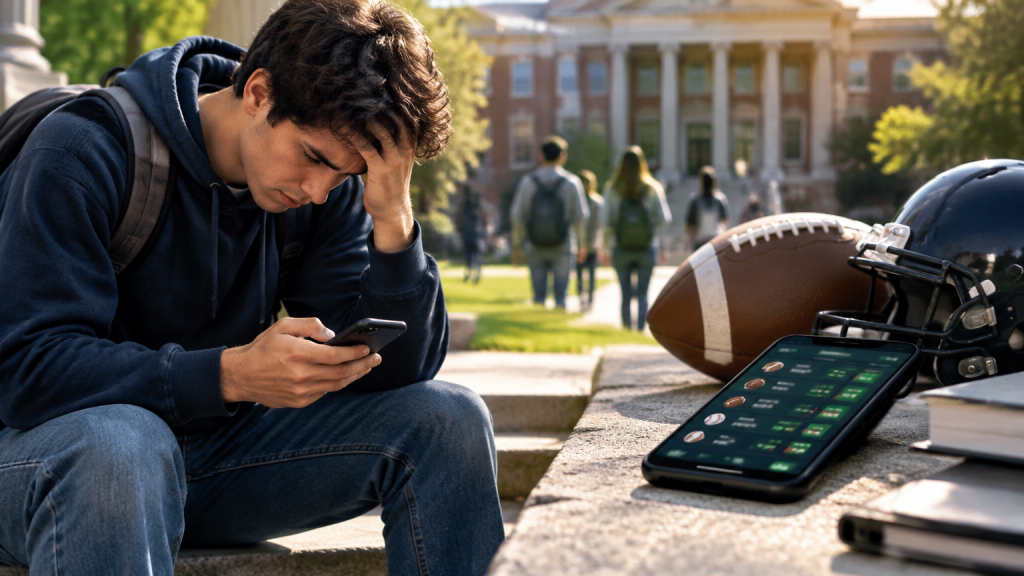
A US House subcommittee has placed college sports betting and student gambling harm under fresh scrutiny, using a nearly two-hour hearing to examine how online wagering is affecting university campuses, student athletes and the integrity of college competition.
The hearing by the Subcommittee on Higher Education and Workforce Development took place on Veterans Day, a federal holiday when much of the country was away from work. Lawmakers and witnesses used the session to discuss a subject that has moved quickly from a niche policy issue to a national concern as legal sports betting, mobile apps and wagering-related media have become more visible across American sport.
While the hearing focused mainly on college students and athletes, the broader context was clear: public health researchers and elected officials are increasingly concerned about gambling-related harm across vulnerable groups. The source material cited recent Kindbridge Behavior Research findings indicating that active-service members screen positive for problem gambling at a rate of 68.6%, nearly four times the rate of the general population. For lawmakers, that data formed part of a wider warning about the speed and scale at which gambling risks can emerge.
Lawmakers Focus on Gambling Harm on Campus
From the start of the hearing, Rep. Michael Baumgartner, the subcommittee’s vice chair, framed problem gambling among college students as an issue that requires attention from policymakers, universities and the betting sector.
Baumgartner pointed to findings from an undergraduate survey released the previous month. According to the figures cited at the hearing, 31% of male students and 25% of female students said they knew someone who had faced financial distress or academic consequences connected to online wagering losses.
He also highlighted concerns that students who had gambled online reported greater difficulty covering essential costs. The expenses discussed included medication, transportation and housing, underscoring that the consequences of betting losses can extend well beyond entertainment budgets.
The hearing’s campus focus reflected a central tension in the modern US betting market. College students are legally adults in many contexts, are often heavy users of mobile technology and may be highly engaged with sports. At the same time, many students face limited income, academic pressure and social environments where risky behavior can spread quickly through peer groups.
Witnesses Address Addiction, Debt and Recovery
The panel heard from experts with backgrounds in mental health treatment, addiction recovery, regulation and sports integrity. Cindy Clouner of The Ohio State University and Dr. Lindsey Mortenson of the University of Michigan were identified as specialists in research related to mental health treatment and addiction recovery.
Their presence reflected the hearing’s public health dimension. Although sports betting is often discussed in terms of tax revenue, market competition and consumer choice, lawmakers also examined the personal consequences associated with compulsive play, debt accumulation and loss chasing.
Those topics are particularly relevant on campuses, where students may lack financial stability or experience managing credit, loans and other obligations. The hearing did not present gambling harm as a single-issue problem, but as one that can intersect with anxiety, depression and other mental health pressures.
Student-Athlete Harassment and Integrity Concerns
Another major theme was the effect of betting markets on student athletes. Dr. Daniel Durkin, an associate professor at the University of Mississippi, answered questions about how sports betting has exposed athletes to harassment and raised concerns about the integrity of college competition.
Durkin described how gambling pressure can reach athletes through personal relationships, not only through outside bettors. He warned that a student-athlete could be placed in a difficult situation if a roommate or trusted peer with gambling problems asked for seemingly small on-court actions, such as missing free throws, rather than an obvious attempt to lose a game.
That scenario goes to the heart of integrity concerns in college sport. Even minor in-game actions can carry betting significance when markets allow wagers on specific events, player statistics or narrow outcomes. For athletes who are young, socially connected and under pressure, the risk is not limited to professional gamblers attempting to influence games. It can also arise within the close personal networks that define campus life.
The hearing came as federal prosecutors in Philadelphia continued to address a wide-ranging point-shaving case involving college basketball. According to the source material, the case has been described as one of the most serious match-fixing investigations in the sport since the CCNY scandal of 1951. Mississippi resident Marves Fairley has pleaded guilty to multiple charges connected to the conspiracy, and former Southern Miss guard Arlando Arnold entered a guilty plea last month.
College Player Prop Bets Under the Microscope
Massachusetts Gaming Commission Chair Jordan Maynard was the only regulator on the witness panel. Maynard told the subcommittee that Massachusetts has implemented a ban on prop wagers involving college athletes.
Player proposition bets, commonly known as prop bets, allow customers to wager on specific individual outcomes. In college sports, critics argue that such markets can increase pressure on student athletes and create more opportunities for harassment or manipulation. The issue has drawn national attention from NCAA President Charlie Baker, the former governor of Massachusetts, who has advocated for a nationwide ban on college player props.
Baker previously testified at a Senate hearing on sports betting in 2024. He is also scheduled to appear next month at the winter meeting of the National Council of Legislators from Gaming States in Savannah, Georgia, according to the source material.
The discussion also comes after the NBA and its official sports betting partners approved restrictions last month on a number of prop markets deemed problematic. While professional and college sports operate under different systems, the NBA action was presented in the source as part of a broader movement toward reassessing which betting markets create unacceptable risks.
Key Issues Raised at the Hearing
The subcommittee covered a wide range of subjects connected to gambling expansion and college sport. The main themes included:
- Problem gambling among students: Lawmakers reviewed evidence that online wagering losses may contribute to financial hardship and academic disruption.
- Mental health and recovery: Witnesses with addiction and treatment expertise addressed the need to view gambling harm through a public health lens.
- Sports integrity: Testimony explored how betting markets can create incentives for manipulation, particularly in college athletics.
- Harassment of student athletes: The hearing examined how athletes may face pressure or abuse linked to betting outcomes.
- Prop bet restrictions: Massachusetts’ ban on college athlete prop wagers was discussed as one regulatory response.
- Prediction markets and online wagering: Lawmakers also considered broader changes in how Americans engage with event-based betting products.
Why the Hearing Matters for US Sports Betting Policy
The hearing did not produce a single legislative outcome in the source material, but it signaled continued federal interest in the social effects of sports betting. Gambling regulation in the US is largely handled at the state level, creating a patchwork of rules on advertising, market access, responsible gambling requirements and permitted bet types.
College sports present especially complex challenges. Universities are educational institutions, sports programs are embedded in campus culture and athletes may be more exposed to peers, classmates and social media pressure than professional players. At the same time, sports betting operators and regulators must balance consumer demand with safeguards designed to reduce harm.
By bringing together addiction researchers, a state regulator and an academic focused on sports integrity, the House subcommittee highlighted the fact that no single institution can address the issue alone. Universities, athletic departments, regulators, lawmakers, betting companies and public health experts all have roles to play.
Conclusion
The House hearing added to the growing national debate over how legal sports betting should operate around college campuses and student athletes. The testimony underscored concerns about financial harm, addiction, harassment and the integrity of competition, while also drawing attention to regulatory tools such as bans on college player prop bets.
As online wagering continues to evolve, the central question for policymakers is not whether sports betting exists, but how its risks can be managed. The hearing suggested that college sports will remain one of the most sensitive areas in that discussion, particularly where student welfare and public confidence in competition are at stake.